
Earlier this week I had a telephone conversation with an insurance injury management advisor who was querying whether, now that my client had moved interstate, was providing treatment via telehealth impeding her psychological recovery?
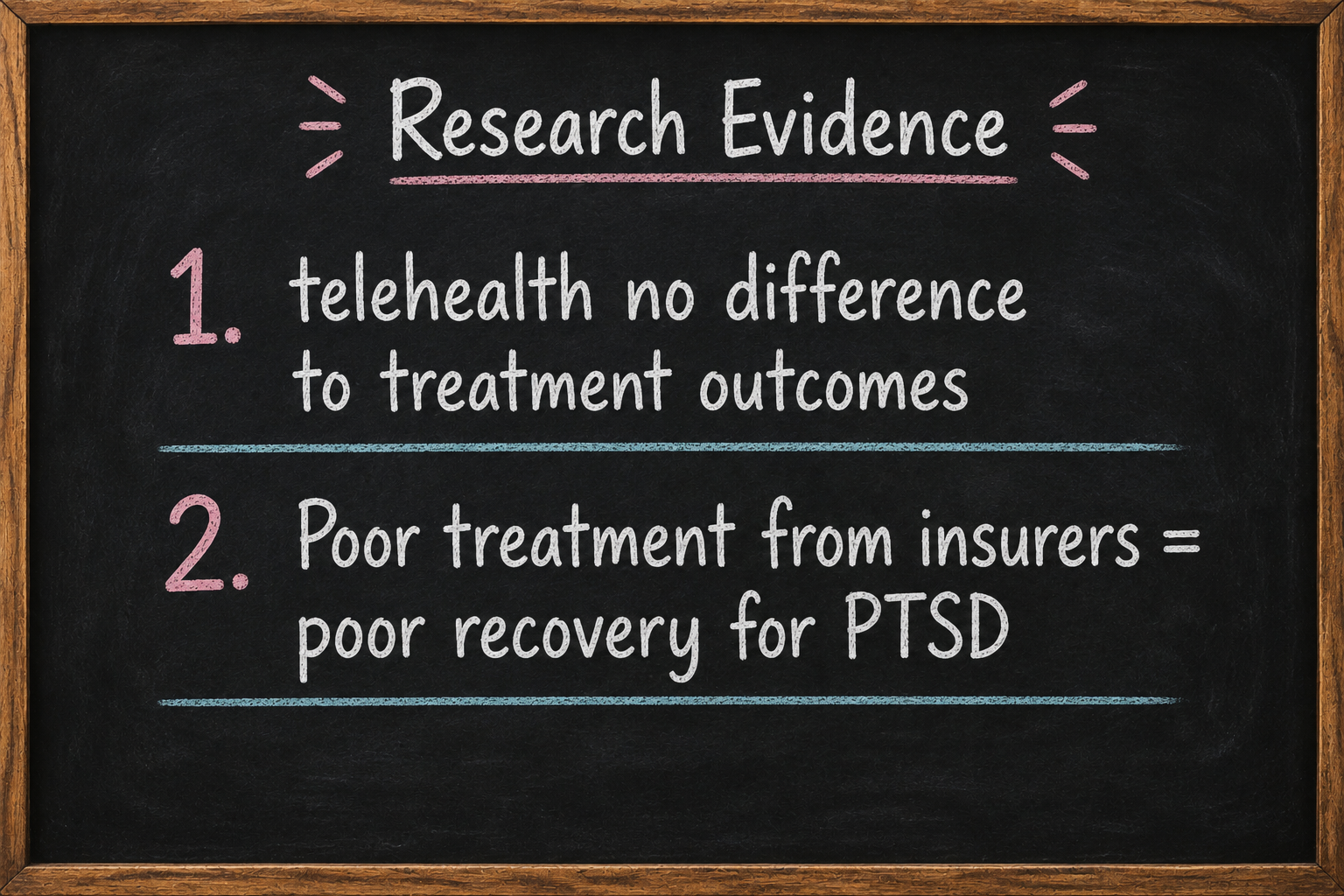
I pointed out that there's actually good evidence to suggest there's no meaningful difference in outcome, and that telehealth works really well.
What was genuinely weighing on her was the stress being caused by the insurer e.g. things not being paid for, approvals being delayed , feeling ghosted.
In other words, the format of the therapy wasn't the problem. The experience of the claim was.
Then I did what I always tell my supervisees to do. I went and checked my facts, rather than trusting that I'd remembered them correctly. Below is a reference list with a brief summary of each study, care of my friend Claude, so you can enjoy using them too. I've confirmed every one of these articles exists - just copy and paste the title into Google or Google Scholar and they'll show up for you to read at your leisure.
Does telehealth get in the way of trauma treatment?
The short answer is no, and the evidence for this is more settled than many injury management systems seem to realise.
Start with EMDR specifically. A 2024 systematic review by Kaptan and colleagues pulled together sixteen studies and more than 1,200 participants and found that EMDR delivered remotely by video produced significant reductions in PTSD symptoms. Where researchers compared online and in-person delivery head to head, the two performed the same. A primary-care study by Liou and colleagues did exactly that comparison and, after accounting for the number of sessions and clinical factors, found no significant difference between virtual and in-person EMDR. McGowan and colleagues evaluated remote EMDR across 93 patients treated by 33 therapists during the pandemic and found significant, clinically meaningful improvements in both adults and children and, tellingly, outcomes weren't tied to how experienced the therapist was.
The honest caveat, which I'd rather say myself than have someone say it for me, is that the EMDR-specific comparative literature is still young and many studies are small. So I don't rest the whole argument on EMDR alone. I lean on the broader and more rigorous evidence for trauma-focused therapy delivered by telehealth, where the picture is very clear. An Australian-led meta-analysis by Scott and colleagues (Bond University) pooled thirteen randomised controlled trials and found no significant difference between telehealth and face-to-face care for PTSD on any measure - symptom severity, depression, the therapeutic alliance, or how satisfied people were with their treatment. Two formal non-inferiority trials back this up: Acierno and colleagues showed that Prolonged Exposure delivered into a person's own home by telehealth was non-inferior to attending in person, and Liu, Morland and colleagues found the same for Cognitive Processing Therapy delivered by videoconference.
If you put all of that together, the claim that telehealth is what's holding a client back simply doesn't have the evidence behind it. The connection over video is real, the therapy still works, and for a client who has moved interstate it may be the only way she gets consistent, trauma-informed care at all.
Similarly, I see people all over country Western Australia, where psychologists are either non-existent or sparse. This way that get to access someone who has 30 years experience working in Workcover WA cases, and experience with work related PTSD.
Turning the mirror around to the insurer: So what actually impedes recovery?
Here's where it gets uncomfortable for the systems that pay for our clients' treatment, because the research points fairly squarely at how the person is treated during the claim.
The landmark study is Grant and colleagues (2014), published in JAMA Psychiatry. They followed 332 Australian compensation claimants over six years and found that the more stressful people found the claims process, the worse their long-term outcomes - more anxiety and depression, more disability, poorer quality of life. That relationship largely held even after adjusting for how vulnerable to stress each person was to begin with. And when you look at what people actually found stressful, none of it is the injury. It's not understanding what's required of them, delays by the compensation organisation, the number of medical assessments, not feeling listened to, and not being treated with respect and dignity. In other words, the conduct of the system was shaping the clinical outcome, years down the line.
Collie and colleagues (2019) put this on a national scale with almost 11,000 injured Australian workers. Those who reported a positive claims experience had an 84 per cent return-to-work rate; those with a negative or neutral experience, 65 per cent. A poor claims experience was associated with roughly 60 per cent lower odds of being back at work. And the workers with mental health conditions were the least likely to report a positive experience and the least likely to be working - the very people most sensitive to how they're treated were the ones most often treated poorly.
Two more studies get at the mechanism, which is fairness. Orchard, Carnide and Smith (2020) followed 585 Victorian claimants over a year and found that feeling poorly informed or disrespected by claim agents predicted higher psychological distress over time - and they were careful to point out that these are modifiable parts of the process. Pavilanis and colleagues (2022) looked specifically at PTSD and found that a sense of injustice was a strong, independent predictor of how severe someone's post-traumatic stress symptoms became, over and above their pain, with the two feeding each other over time. And a 2024 systematic review by Wadhwa and colleagues tied it all together: most studies find that navigating the compensation system is associated with poorer mental health, with the process itself repeatedly named as one of the greatest sources of stress an injured worker faces.
The one thing this literature can't do is prove causation on its own : most of it is associational, and I'd want any psychologist quoting it to say so. But the prospective designs, the dose-response pattern, and the sheer consistency across large samples make it a body of evidence I take seriously in the consulting room.
Why this matters
I don't share this to have a go at insurers or employers. Most of the injury management people I speak with are decent, overworked, and genuinely trying to do the right thing, which is exactly why this evidence is worth knowing. It reframes where the leverage actually is. If we want an injured worker to recover, the mode of therapy is not the dial to turn. Paying for treatment promptly, approving things without unnecessary delay, keeping people informed, and treating them with respect are not just courtesies. On the evidence, they are part of the treatment.
So the next time the question comes up - is telehealth the reason she isn't getting better? — you've got the references to answer it kindly, clearly, and with the literature at your back. The delivery isn't the problem. The way she's being treated might be.
References
On telehealth delivery of trauma-focused therapy
Acierno, R., Gros, D. F., Ruggiero, K. J., Hernandez-Tejada, M. A., Knapp, R. G., Lejuez, C. W., Muzzy, W., Frueh, B. C., Egede, L. E., & Tuerk, P. W. (2016). A non-inferiority trial of Prolonged Exposure for posttraumatic stress disorder: In person versus home-based telehealth. Behaviour Research and Therapy, 89, 57–65. https://doi.org/10.1016/j.brat.2016.11.009
Kaptan, S. K., Kaya, Z. M., & Akan, A. (2024). Addressing mental health need after COVID-19: A systematic review of remote EMDR therapy studies as an emerging option. Frontiers in Psychiatry, 14, 1336569. https://doi.org/10.3389/fpsyt.2023.1336569
Liou, H., Lane, C., Huang, C., Mookadam, M., Joseph, M., & Hecker DuVal, J. (2022). Eye movement desensitization and reprocessing in a primary care setting: Assessing utility and comparing efficacy of virtual versus in-person methods. Telemedicine and e-Health, 28(9). https://doi.org/10.1089/tmj.2021.0454
Liu, L., Thorp, S. R., Moreno, L., Wells, S. Y., Glassman, L. H., Busch, A. C., Zamora, T., Rodgers, C. S., Allard, C. B., Morland, L. A., & Agha, Z. (2020). Videoconferencing psychotherapy for veterans with PTSD: Results from a randomized controlled non-inferiority trial. Journal of Telemedicine and Telecare, 26(9), 507–519. https://doi.org/10.1177/1357633X19853947
McGowan, I. W., Fisher, N., Havens, J., & Proudlock, S. (2021). An evaluation of eye movement desensitization and reprocessing therapy delivered remotely during the Covid-19 pandemic. BMC Psychiatry, 21, 560. https://doi.org/10.1186/s12888-021-03571-x
Scott, A. M., Bakhit, M., Greenwood, H., Cardona, M., Clark, J., Krzyzaniak, N., Peiris, R., & Glasziou, P. (2022). Real-time telehealth versus face-to-face management for patients with PTSD in primary care: A systematic review and meta-analysis. The Journal of Clinical Psychiatry, 83(4), 21r14143. https://doi.org/10.4088/JCP.21r14143
On how insurer and employer conduct affects recovery
Collie, A., Sheehan, L., Lane, T. J., Gray, S., & Grant, G. (2019). Injured worker experiences of insurance claim processes and return to work: A national, cross-sectional study. BMC Public Health, 19, 927. https://doi.org/10.1186/s12889-019-7251-x
Grant, G. M., O'Donnell, M. L., Spittal, M. J., Creamer, M., & Studdert, D. M. (2014). Relationship between stressfulness of claiming for injury compensation and long-term recovery: A prospective cohort study. JAMA Psychiatry, 71(4), 446–453. https://doi.org/10.1001/jamapsychiatry.2013.4023
Orchard, C., Carnide, N., & Smith, P. (2020). How does perceived fairness in the workers' compensation claims process affect mental health following a workplace injury? Journal of Occupational Rehabilitation, 30(1), 40–48. https://doi.org/10.1007/s10926-019-09844-3
Pavilanis, A., Truchon, M., Achille, M., Côté, P., & Sullivan, M. J. L. (2022). Perceived injustice as a determinant of the severity of post-traumatic stress symptoms following occupational injury. Journal of Occupational Rehabilitation. Advance online publication. https://doi.org/10.1007/s10926-022-10056-5
Wadhwa, S., Taouk, Y., Spittal, M. J., & King, T. (2024). Workplace injury compensation and mental health and self-harm outcomes: A systematic review. NEW SOLUTIONS: A Journal of Environmental and Occupational Health Policy, 34(2), 71–82. https://doi.org/10.1177/10482911241254836
A note on the references: I've checked that each of these studies exists. Just copy and paste the title into Google or Google Scholar and it will come up for you to read in full.